
Mazda 3 Service Manual: Towing
-
Proper lifting and towing are necessary to prevent damage to the vehicle. Government and local laws must be followed.
-
A towed vehicle usually should have its drive wheel (front wheels) off the ground. If excessive damage or other conditions prevent this, use wheel dollies.
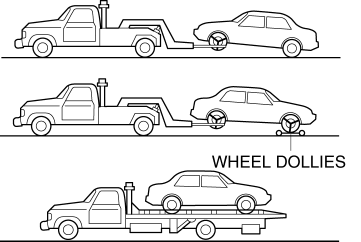
-
When towing with the rear wheels on the ground, release the parking brake.
CAUTION:
-
Do not tow the vehicle pointed backward with driving wheels on the ground. This may cause internal damage to the transaxle.
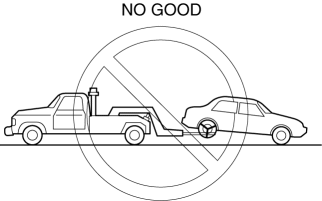
CAUTION:
-
Do not tow with sling–type equipment. This could damage your vehicle. Use wheel–lift or flatbed equipment.
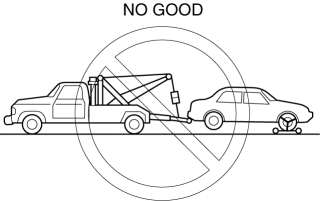
Vehicle Securing Position
-
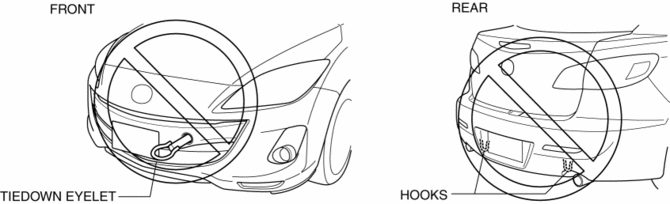
When transporting the vehicle by flat bed tow truck or trailer, secure the vehicle to the trailer using the holes and left tiedown loop shown in the figure.
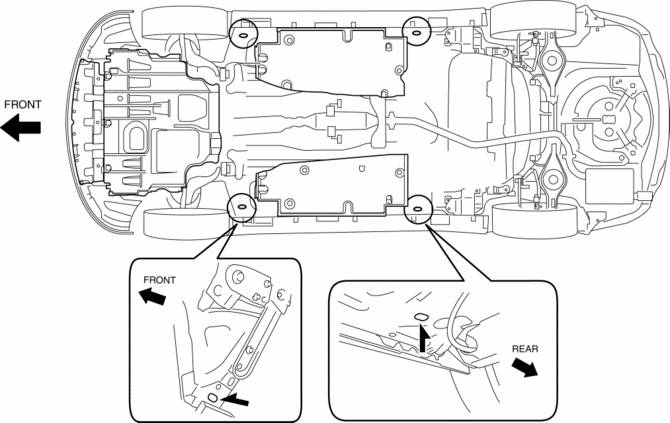
CAUTION:
-
To prevent damage to the vehicle, do not use the tiedown eyelet (front) and the left/right tiedown loops (rear) for towing the vehicle using another vehicle.
-
Do not use the tie-down eyelet and rear hook for tying down the vehicle onto a trailer and flatbed tow truck. It may cause damage to the vehicle.
NOTE:
-
The tiedown eyelet (front) and the tiedown loops (rear) are used only when the vehicle is transported by ship.
 Trailer
...
 Body
Body
...
Other materials:
EGR Valve Removal/Installation [Mzr 2.0, Mzr 2.5]
1. Remove the battery cover..
2. Disconnect the negative battery cable..
3. Drain the engine coolant from the radiator..
4. Remove the air cleaner and the air hose as a single unit..
5. Remove the radiator hose (upper, engine side)..
6. Disconnect the EGR valve connector.
7. Remove in th ...
Auto Leveling Sensor Removal/Installation
1. Disconnect the negative battery cable..
2. Lift up the vehicle.
3. Disconnect the quick release connector. (charcoal canister side).
4. Remove in the order indicated in the table.
1
Bolt
2
Connector
3
Auto ...
Rearview Mirror
WARNING
Do not stack cargo or objects higher
than the seatbacks:
Cargo stacked higher than the
seatbacks is dangerous. It can block
your view in the rearview mirror, which
might cause you to hit another car
when changing lanes.
Rearview mirror adjustment
Before dri ...
