
Mazda 3 Owners Manual: Overheating
If the high engine coolant temperature warning light illuminates, the vehicle loses power, or you hear a loud knocking or pinging noise, the engine is probably too hot.
| WARNING
Open the hood ONLY after steam is no longer escaping from the engine: Steam from an overheated engine is dangerous. The escaping steam could seriously burn you. |

 Do not remove either
If the high engine coolant temperature warning light illuminates:
- Drive safely to the side of the road and park off the right-of-way.
- Put a vehicle with an automatic transaxle in park (P), a manual transaxle in neutral.
- Apply the parking brake.
- Turn off the air conditioner.
- Check whether coolant or steam is escaping from the engine compartment.
If steam is coming from the engine compartment: Do not go near the front of the vehicle.
Stop the engine.
Wait until the steam dissipates, then open the hood and start the engine.
If neither coolant nor steam is escaping: Open the hood and idle the engine until it cools.
| CAUTION If the cooling fan does not operate while the engine is running, the engine temperature will increase. Stop the engine and call an Authorized Mazda Dealer. |
- Make sure the cooling fan is operating, then turn off the engine after the temperature has decreased.
- When cool, check the coolant level.
If it is low, look for coolant leaks from the radiator and hoses.
If you find a leak or other damage, or if coolant is still leaking:
Stop the engine and call an Authorized Mazda Dealer.
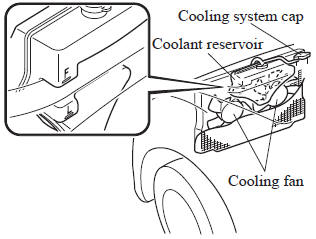
If you find no problems, the engine is cool, and no leaks are obvious:
Carefully add coolant as required .
| CAUTION If the engine continues to overheat or frequently overheats, have the cooling system inspected. The engine could be seriously damaged unless repairs are made. Consult an Authorized Mazda Dealer. |
 Push-Starting
Do not push-start your Mazda.
WARNING
Never tow a vehicle to start it:
Towing a vehicle to start it is
dangerous. The vehicle being towed
could surge forward when its engine
sta ...
 Emergency Towing
...
Other materials:
Brake Hose (Front) Removal/Installation [Mzr 2.3 Disi Turbo]
1. Remove in the order indicated in the table.
2. Install in the reverse order of removal.
3. Add brake fluid, bleed the brakes, and inspect for leakage after the installation
has been completed..
1
Brake pipe
2
Clip
3
...
On Board Diagnostic System Simulation Inspection [Fw6 A EL]
1. Connect the M-MDS (IDS) to the DLC-2.
2. After the vehicle is identified, select the following items from the initialization
screen of the IDS.
a. Select “DataLogger”.
b. Select “Modules”.
c. Select “TCM”.
3. Select the simulation items from the PID table.
4. Perform ...
Drive Belt Auto Tensioner Inspection [Skyactiv G 2.0]
WARNING:
A hot engine can cause severe burns. Turn off the engine and wait until it
is cool before servicing.
CAUTION:
If the rubber part of the drive belt auto tensioner is damaged by a screwdriver
or other tool, oil in the hydraulic pressure unit could leak and the tens ...
