
Subaru Solterra 2023-2026 Owner's Manual: SRS airbags
The SRS airbag system in the Subaru Solterra is engineered to deploy during specific types of severe impacts that may otherwise cause serious harm to vehicle occupants. These advanced airbags function in combination with seat belts to significantly reduce the risk of fatal or severe injuries.
SRS airbag system
■ Location of the SRS airbags
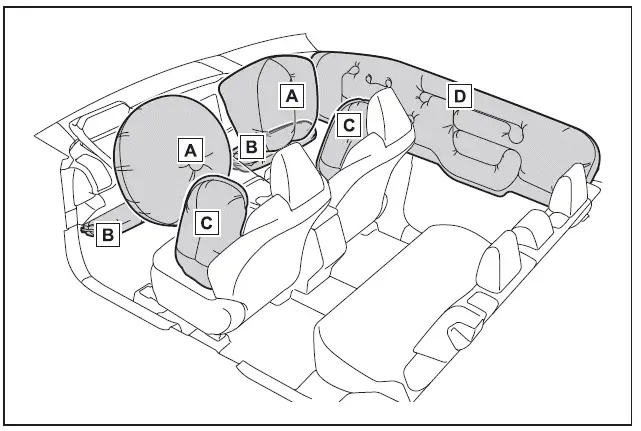
- SRS driver airbag/front passenger airbag
Designed to reduce impact forces to the head and chest area of both the driver and front passenger in the Subaru Solterra - SRS knee airbags
Provide additional protection by reducing impact to the lower body of the driver and front passenger - SRS side airbags
Help protect the chest area of front seat occupants during side collisions in the Subaru Solterra - SRS curtain shield airbags
- Extend along the sides of the cabin to protect the heads of front and rear outer seat occupants
- Assist in preventing occupants from being ejected from the Subaru Solterra during rollover events
Your Subaru Solterra is equipped with ADVANCED AIRBAGS that comply with U.S. motor vehicle safety regulations (FMVSS208). The airbag control unit (ECU) determines deployment timing and intensity based on data collected from multiple sensors throughout the vehicle. These sensors monitor factors such as crash severity, impact direction, and occupant status. Upon activation, a rapid chemical reaction generates non-toxic gas, inflating the airbags instantly to help restrain occupant movement.
■ If the SRS airbags deploy (inflate)
- Due to the extremely rapid deployment of the SRS airbags in the Subaru Solterra, occupants may experience minor abrasions, burns, or bruising caused by the hot gases used during inflation.
- A loud deployment sound and the release of a fine white powder are normal during airbag activation.
- Components of the airbag system, including the steering wheel hub, airbag covers, and inflators, may remain hot for several minutes after deployment. The airbag material itself may also be warm.
- The windshield may crack as a result of the force generated during airbag deployment.
- The EV system of the Subaru Solterra will automatically shut down to enhance safety.
- All vehicle doors will unlock automatically to facilitate quick exit.
- The braking system and stop lights may activate automatically following deployment.
- The interior lighting will turn on automatically to improve visibility.
- The hazard warning lights (emergency flashers) will activate automatically.
- For Subaru Solterra vehicles equipped with SUBARU SOLTERRA CONNECT, the
system is designed to automatically initiate an emergency call to a response
center in certain critical situations. The system transmits the vehicle’s
location without requiring manual activation of the SOS button. A trained operator
will attempt to communicate with the occupants to determine the level of emergency
and arrange appropriate assistance. If no response is received, emergency services
are dispatched automatically.
- When an SRS airbag has deployed
- When a seat belt pretensioner has been activated
- When the Subaru Solterra is involved in a severe rear-end collision
■ The SRS airbags deploy in a frontal impact when
- The following airbags in the Subaru Solterra will deploy when the force
of impact exceeds a predetermined threshold, approximately equivalent to a frontal
collision at 12–18 mph (20–30 km/h) with a rigid, non-deforming barrier:
- SRS front airbags
- SRS knee airbags
- The deployment threshold may be higher than normal under certain conditions,
such as:
- When the Subaru Solterra collides with an object that moves or deforms upon impact, like another vehicle or a roadside sign
- In underride collisions where the front of the vehicle slides beneath another object, such as the rear of a truck
- Depending on the nature and angle of the collision, only certain restraint
systems may activate, including:
- Seat belt pretensioners
- SRS knee airbags
- The front passenger airbag system in the Subaru Solterra may not deploy if the seat is unoccupied. However, in some cases, deployment may still occur if significant weight, such as luggage, is placed on the seat.
- In particularly severe frontal collisions, the curtain shield airbags on both sides of the Subaru Solterra may also deploy to provide additional head protection.
Additional safety insight: The advanced SRS airbag system in the Subaru Solterra is designed to work seamlessly with other safety technologies, creating a comprehensive protection network that responds dynamically to real-world driving conditions and collision scenarios.
■ The SRS airbags deploy in a side impact when
- In the Subaru Solterra, the following SRS airbags are designed to deploy
when the force of a side collision exceeds a defined threshold. This threshold
generally corresponds to an impact similar to a vehicle weighing approximately
1500 kg (3300 lb.) striking the passenger compartment at a perpendicular angle
at a speed of around 12–18 mph (20–30 km/h):
- SRS side airbags
- SRS curtain shield airbags
- During a side collision in the Subaru Solterra, both left and right curtain shield airbags may deploy regardless of which side of the vehicle is impacted, providing enhanced head protection for all occupants.
- If the Subaru Solterra experiences a rollover event, the curtain shield airbags on both sides are automatically activated to help protect occupants and reduce the risk of ejection.
■ The SRS airbags deploy in an underside impact when
- If the underside of the Subaru Solterra strikes a rigid object, such as
a road obstacle or curb, multiple airbag systems may deploy depending on the
severity of the impact:
- SRS front airbags
- SRS knee airbags
- SRS side airbags
- SRS curtain shield airbags
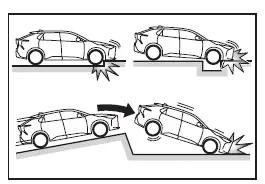
- The SRS curtain shield airbags in the Subaru Solterra may also deploy if the vehicle tilts significantly or experiences a strong lateral impact, such as skidding into a curb or barrier.
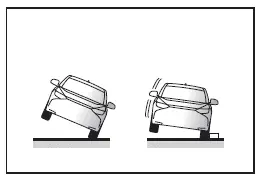
■ The SRS side airbags will not deploy when
- In certain collision scenarios, the SRS airbags in the Subaru Solterra may
not deploy. For example, front airbags and knee airbags are generally not activated
during side or rear impacts, rollovers, or low-speed frontal collisions. However,
if such impacts generate sufficient deceleration force, deployment may still
occur:
- SRS front airbags
- SRS knee airbags
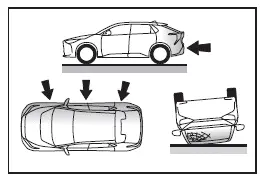
- SRS side airbags and curtain shield airbags in the Subaru Solterra may not
activate if the impact occurs at certain angles or affects areas outside the
passenger compartment, reducing the force transferred to occupant protection
zones:
- SRS side airbags
- SRS curtain shield airbags
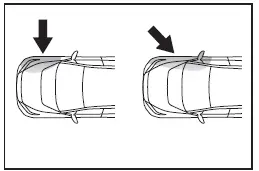
- SRS side airbags are not typically deployed during frontal or rear-end collisions,
rollovers, or low-speed side impacts in the Subaru Solterra, unless impact forces
exceed system thresholds:
- SRS side airbags
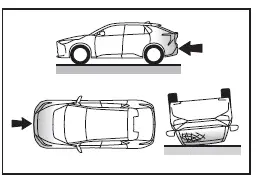
- SRS curtain shield airbags are generally not activated in rear-end collisions,
end-over-end rollovers, or low-speed impacts from the front or sides, unless
the force is sufficient to trigger the system:
- SRS curtain shield airbags
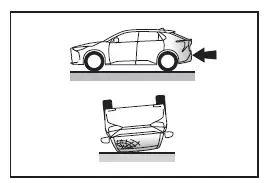
■ When to contact your SUBARU dealer
If any of the following situations occur with your Subaru Solterra, it is essential to have the vehicle inspected and, if necessary, repaired by an authorized SUBARU dealer as soon as possible to maintain safety and proper system functionality.
- If any SRS airbag in your Subaru Solterra has deployed, regardless of the severity of the incident
- If the front section of the Subaru Solterra has been damaged, deformed,
or involved in a collision that did not trigger deployment of the following
airbags:
- SRS front airbags
- SRS knee airbags
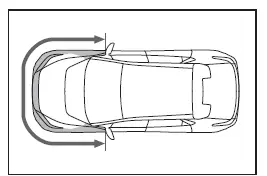
- If a door, or the surrounding structure, has been damaged, deformed, or
penetrated, even if the collision was not severe enough to activate:
- SRS side airbags
- SRS curtain shield airbags
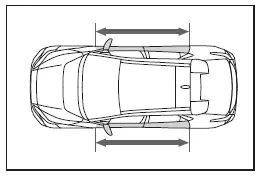
- If the steering wheel center pad, dashboard near the front passenger airbag, or lower instrument panel shows signs of cracks, scratches, or damage
- If the seat surface containing the SRS side airbag is damaged or worn
- If interior trim components such as front pillars, rear pillars, or roof side rails covering curtain airbags are damaged in any way
Additional safety note: Regular inspection of the Subaru Solterra airbag system after any impact ensures that all protective components remain fully operational and ready to respond effectively in future emergency situations.
WARNING
■ SRS airbag precautions
Carefully follow all safety precautions outlined below when operating your Subaru Solterra.
Failure to observe these instructions may significantly increase the risk of serious injury or fatal consequences.
- All occupants of the Subaru Solterra must always wear their seat belts
correctly.
The SRS airbag system is designed as a supplemental restraint and works in combination with seat belts, not as a replacement.
- The SRS driver airbag in the Subaru Solterra deploys with substantial force and speed. If the driver is seated too close to the steering wheel, this can result in severe injury or death. According to recommendations from the National Highway Traffic Safety Administration (NHTSA):
The highest risk zone for airbag deployment is within the first 2–3 inches (50–75 mm) of inflation. Maintaining a minimum distance of approximately 10 inches (250 mm) between your chest and the steering wheel significantly reduces this risk in the Subaru Solterra.
If your current driving position in the Subaru Solterra places you too close to the airbag, consider adjusting your seating position using the following methods:
- Move the driver’s seat backward as far as possible while still maintaining comfortable access to the pedals and controls.
- Slightly recline the seatback.
Even small adjustments can help achieve the recommended safe distance. If visibility becomes limited, use a firm, non-slip cushion or raise the seat height if your Subaru Solterra is equipped with this feature.
- If your Subaru Solterra features an adjustable steering wheel, tilt it downward so that the airbag deploys toward your chest rather than your head or neck. Ensure that all adjustments still allow safe control of the vehicle and a clear view of the instrument panel.
- If a seat belt extender is connected to the front seat buckle but the main seat belt is not properly fastened into the extender, the system may incorrectly detect that the occupant is secured. This may prevent proper deployment of the SRS airbags in the Subaru Solterra during a collision, increasing the risk of injury. Always ensure the seat belt is correctly fastened when using an extender.
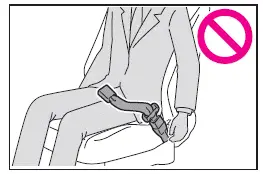
- The front passenger airbag in the Subaru Solterra also deploys with significant force. The passenger seat should always be positioned as far back as possible, with the seatback upright, to maintain a safe distance from the airbag.
- Infants and children who are not properly restrained are at extremely high risk during airbag deployment. Children too small to use a seat belt must be secured in an appropriate child restraint system. Subaru strongly recommends that all children ride in the rear seats of the Subaru Solterra, which provide a safer environment than the front passenger seat.
- Do not sit on the edge of the seat or lean forward toward the dashboard, as this reduces the effectiveness of the airbag protection system.
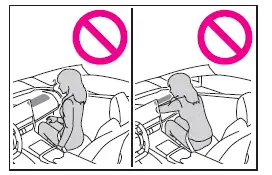
- Front seat occupants in the Subaru Solterra should never hold objects on their lap during driving, as these may become hazardous projectiles during airbag deployment.
- Never allow a child to stand in front of the front passenger airbag or sit on the lap of a front passenger while the vehicle is in motion.
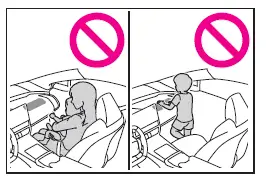
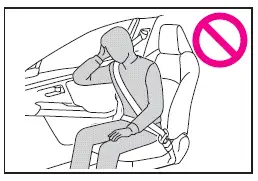
- Do not lean against the door, roof side rail, or front, side, or rear pillars, as this may place your body too close to side or curtain airbags in the Subaru Solterra.
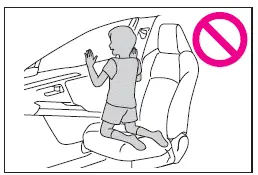
- Do not allow passengers to kneel on the seats facing the doors or extend their head, arms, or hands outside the Subaru Solterra, as this creates a high risk of injury in the event of sudden movement or airbag deployment.
Additional safety recommendation: Proper seating posture and maintaining safe distances from airbag deployment zones in the Subaru Solterra significantly enhance the effectiveness of the entire restraint system, ensuring maximum protection for all occupants in emergency situations.
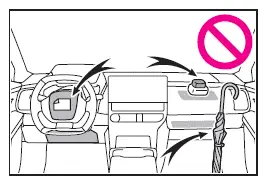
- Do not attach any objects to, or place pressure against, critical areas such as the dashboard, steering wheel center pad, or the lower section of the instrument panel in your Subaru Solterra.
- Avoid attaching accessories or objects to surfaces such as doors, windshield, side windows, front and rear pillars, roof side rails, and assist grips, as these areas are closely integrated with the SRS airbag deployment zones in the Subaru Solterra.
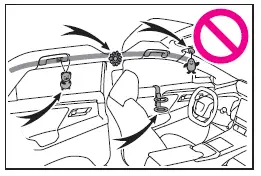
- Do not hang coat hangers, bags, or other rigid items on the coat hooks inside your Subaru Solterra. In the event of curtain airbag deployment, these objects may become dangerous projectiles, potentially causing severe injury or death.
- If a vinyl cover or protective accessory is installed over the area where the SRS knee airbag deploys, it must be removed immediately to ensure proper airbag operation.
- Do not install seat covers or accessories that obstruct the deployment zones of SRS airbags in the Subaru Solterra. Such items may interfere with airbag inflation, prevent proper deployment, or even trigger unintended activation, significantly increasing the risk of injury.
- Avoid striking or applying excessive force to components associated with
the SRS airbag system, including front doors and surrounding structural areas
of the Subaru Solterra.
Improper handling may damage sensitive components and lead to system malfunction.
- After the SRS airbags have deployed, do not touch any related components immediately, as they may remain extremely hot and could cause burns.
- If you experience breathing discomfort following airbag deployment in the Subaru Solterra, ventilate the cabin by opening doors or windows, or exit the vehicle if it is safe. Clean any residue from skin promptly to avoid irritation.
- If any part of the airbag system housing or surrounding trim is cracked, damaged, or deformed, it must be inspected and replaced by an authorized SUBARU dealer.
- Do not place objects such as cushions on the front passenger seat. This may alter weight detection and prevent the system from correctly identifying an occupant, potentially disabling proper deployment of the front passenger airbag in the Subaru Solterra.
WARNING
■ Modification and disposal of SRS airbag system components
Never attempt to modify, dismantle, or dispose of your Subaru Solterra or its SRS airbag system components without consulting an authorized SUBARU dealer. Improper handling may result in unintended deployment or system failure, which could lead to severe injury or death.
- Do not remove, install, disassemble, or repair any SRS airbag components on your Subaru Solterra самостоятельно.
- Avoid any repairs, removal, or modifications involving the following
parts or surrounding areas:
- Steering wheel
- Instrument panel
- Dashboard
- Seats
- Seat upholstery
- Front pillars
- Side pillars
- Rear pillars
- Roof side rails
- Front door panels
- Front door trim
- Front door speakers
- Do not modify front door panels, including drilling or creating openings, as this may interfere with SRS airbag deployment in the Subaru Solterra.
- Avoid repairs or structural modifications involving the following areas:
- Front fender
- Front bumper
- Interior side structures of the Subaru Solterra
- Do not install external accessories that may affect crash dynamics or
sensor operation, including:
- Bull bars or kangaroo bars
- Snow plows
- Winches
- Roof-mounted luggage carriers
- Do not modify the suspension system of the Subaru Solterra, as it may alter crash response behavior and airbag timing.
- Avoid installing non-approved electronic devices such as high-power radio transmitters or aftermarket multimedia equipment that may interfere with vehicle electronics.
- Any modifications made to accommodate a person with physical disabilities must be carefully evaluated and performed only under professional guidance to ensure compatibility with the Subaru Solterra safety systems.
Additional safety insight: Maintaining the original design and integrity of the Subaru Solterra SRS airbag system is essential for ensuring optimal protection, as even minor unauthorized modifications can compromise the effectiveness of critical safety features.
 Seat belts
Before driving your Subaru Solterra, always confirm that every occupant
is properly secured with a seat belt. Correct usage of seat belts is one of the
most critical safety measures in preventing ...
 Front passenger occupant classification system
The Subaru Solterra is equipped with an advanced front passenger
occupant classification system that continuously monitors the status of the front
passenger seat. Based on detected conditions, thi ...
Other materials:
Bass Box Inspection
1. Disconnect the negative battery cable..
2. Disconnect the connector..
3. Verify the resistance between bass-box terminals.
If not within the specification, replace the bass-box.
Resistance
0.9—1.1 ohms
...
AC charging cable
This section explains the functionality, proper handling procedures,
and safety considerations for the AC charging cable used with the Subaru Solterra,
ensuring efficient and secure charging in everyday use.
WARNING
■ When using the AC charging cable and CCID (Charging Circuit Interrupting
...
Brake Fluid Pressure Sensor Inspection
1. Switch the ignition to off.
2. Install the SSTs to the master cylinder (secondary side) as shown in
the figure.
NOTE:
When installing the SST (49 D043 0A0) to the master cylinder, use
a commercially available flare nut wrench (flare nut across flat 12 mm {0.47
in}).
...
