
Subaru Solterra 2023-2026 Owner's Manual: Electric Vehicle system features
The Subaru Solterra represents a new generation of mobility, where battery electric vehicle technology significantly differs from traditional gasoline-powered vehicles in both operation and driving experience.
Instead of relying on internal combustion, the Subaru Solterra uses energy stored in a high-capacity traction battery to power its electric motors. Because it operates purely on electricity, the Subaru Solterra produces zero tailpipe emissions, meaning no CO2 (Carbon Dioxide) or NOx (Nitrogen Oxides), making it an environmentally responsible and forward-thinking vehicle choice.
System components
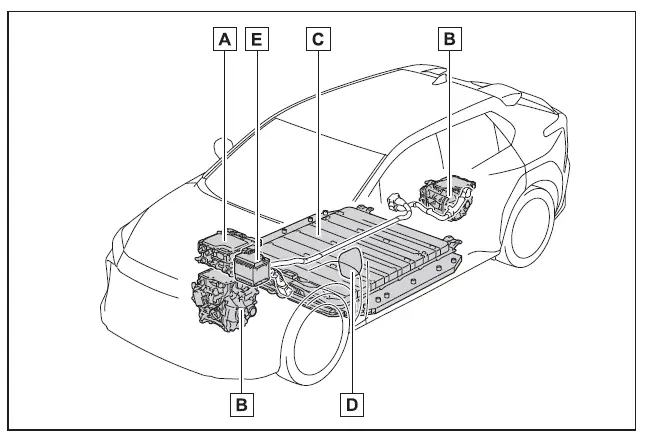
The illustration is provided for explanatory purposes and may vary slightly from the actual configuration of your Subaru Solterra.
- ESU: Electricity Supply Unit (integrated onboard charger and DC-DC converter for efficient energy management)
- Electric motor (traction motor)/Inverter (front and rear units delivering smooth all-wheel drive performance)
- Traction battery
Supplies electrical energy required to drive the Subaru Solterra. - Charging port
- 12-volt battery
Powers essential systems such as SRS airbags, lighting, wipers, and onboard electronics.
■ When braking (regenerative braking)
During deceleration, the Subaru Solterra utilizes regenerative braking, where the electric motor converts kinetic energy back into electrical energy and stores it in the traction battery.
This intelligent energy recovery system helps extend the driving range of the Subaru Solterra when used effectively in everyday driving conditions.
Charging
The Subaru Solterra operates entirely on electricity, which must be replenished by connecting to an external power source and stored in the traction battery. Charging can be performed using public charging stations or standard household outlets, providing flexibility for drivers.
Unlike refueling a conventional vehicle, charging procedures for the Subaru Solterra require understanding of specific equipment and processes.
It is strongly recommended to familiarize yourself with the following topics to ensure safe and efficient charging:
- Charging equipment
- AC charging cable
- Compatible power sources
- Important precautions before charging
- Step-by-step charging procedures
- Troubleshooting when charging does not function normally
■ Regenerative braking
The Subaru Solterra converts motion energy into electricity in several driving scenarios, providing both deceleration and battery recharging benefits.
- When the accelerator pedal is released while driving in D position.
- When the brake pedal is applied while driving in D position.
■ Charging the 12-volt battery
The 12-volt battery in the Subaru Solterra is automatically charged from the traction battery whenever the EV system is active or while the main battery is being charged.
If the vehicle remains unused for extended periods, the 12-volt battery may gradually discharge due to natural energy loss. In such cases, proper recovery procedures should be followed.
■ When not using the vehicle for an extended period of time
- When storing the Subaru Solterra for a long period, it is recommended to
charge the traction battery at least once per month.
This helps maintain battery health and prevents deep discharge conditions.
- During long-term storage, the 12-volt battery may be periodically supported
by the traction battery to minimize discharge risks.
The cooling fan may operate during this process, which is normal and not a malfunction.
- To avoid unnecessary battery drain, ensure that the charging port lid is closed and the charging cable is disconnected when not actively charging the Subaru Solterra.
■ Charging the traction battery
Maintaining an appropriate charge level in the traction battery is essential for reliable operation of the Subaru Solterra.
If the traction battery becomes fully depleted, the vehicle will be unable to move. Therefore, it is important to recharge the battery promptly when low.
■ If the traction battery becomes low
- When the battery level is low, a warning indicator will illuminate or flash, and a message will appear on the multi-information display in the Subaru Solterra.
- If the battery is completely discharged, the EV system cannot be started and the vehicle cannot be driven until recharged.
■ Sounds and vibrations specific to a battery electric vehicle
Because the Subaru Solterra operates without a traditional engine, it produces minimal noise and vibration. This can sometimes lead to confusion, as the vehicle may appear to be off even when it is active, indicated by the "READY" light.
For safety, always shift the Subaru Solterra into P and engage the parking brake when parked.
Various operational sounds may be heard before or after starting the EV system. These are normal characteristics of electric vehicle operation and do not indicate a malfunction:
- Brake system activation sounds when the driver’s door is opened.
- Electric motor noise from the motor or luggage compartments.
- Electrical relay clicks when the system starts or stops.
- Relay sounds from the traction battery in the following situations:
- When starting or stopping the EV system
- When charging begins or ends
- During the first drive after DC fast charging
- Energy recovery sounds during regenerative braking.
- Cooling fan operation from the radiator system.
- Air conditioning system operation, including compressor and blower motor sounds.
■ Maintenance, repair, recycling, and disposal
For any maintenance, repair, recycling, or disposal of your Subaru Solterra, always consult an authorized SUBARU dealer. Improper handling of electric vehicle components can be hazardous.
Acoustic Vehicle Alerting System
The Subaru Solterra is equipped with an Acoustic Vehicle Alerting System (AVAS), which generates a sound that varies with vehicle speed to alert pedestrians and nearby individuals of the vehicle’s presence.
This sound may also be audible inside the vehicle and will automatically stop once the Subaru Solterra exceeds approximately 23 mph (37 km/h).
■ Acoustic Vehicle Alerting System
There are situations where the AVAS sound may be less noticeable to окружающих:
- In environments with high ambient noise levels
- During strong wind or heavy rain conditions
Additionally, because the system is located at the front of the Subaru Solterra, the alert sound may be less audible from the rear compared to the front of the vehicle.
Understanding these operational characteristics will help Subaru Solterra drivers use the vehicle more safely and efficiently while benefiting from its advanced electric technology.

 Electric Vehicle system precautions
When operating or servicing the Subaru Solterra, it is essential
to remain aware of the presence of high-voltage components (nominal voltage approximately
355.2 V), including the traction battery, ...
Other materials:
Refrigerant Charging
CAUTION:
Do not exceed the specification when charging the system with refrigerant.
Doing so will decrease the efficiency of the air conditioner or damage the refrigeration
cycle parts.
Charging Recycled HFC-134a Refrigerant
1. Connect an HFC-134a recovery/recycling/recharging d ...
Supplemental Restraint System (SRS) Precautions
The front and side supplemental restraint systems (SRS) include different
types of air bags.
Please verify which kinds of air bags are equipped on your vehicle by locating
the
“SRS AIRBAG” location indicators. These indicators are visible in the area where
the air
bags are installed.
...
Clock Switch Inspection
NOTE:
Clock switch built with the hazard warning switch.
1. Disconnect the negative battery cable..
2. Remove the clock switch..
3. Verify resistance between the clock switch terminals.
If the resistance is not as specified, replace the clock switch.
Between t ...
