
Mazda 3 Owners Manual: SRS Air Bag Deployment Criteria
This chart indicates the applicable SRS equipment that will deploy depending on the type of collision.
(The illustrations are the representative cases of collisions.)
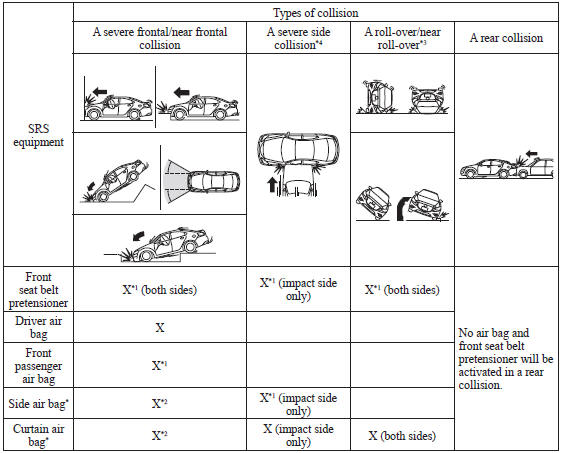
X: The SRS air bag equipment is designed to deploy in a collision.
*1 (With Front Passenger Occupant Classification System) The front passenger front and side air bags and the seat belt pretensioner are designed to deploy depending on the condition of the total seated weight on the front passenger seat.
*2 (With Front Passenger Occupant Classification System) In an angled collision, the side air bag and curtain air bag may deploy.
*3 (With Front Passenger Occupant Classification System) In a roll-over accident, the seat belt pretensioners and the curtain air bags deploy.
*4 (With Side/Curtain Air Bags) In a side collision, the seat belt pretensioners and the side/curtain air bags deploy (only on the side in which the collision occurs).
 How the SRS Air Bags Work
Your Mazda is equipped with the following types of SRS air bags. SRS air bags
are
designed to work together with the seat belts to help to reduce injuries during
an accident.
The SRS air bags ...
 Limitations to SRS Air Bag
In severe collisions such as those described previously in "SRS Air Bag
Deployment
Criteria", the applicable SRS air bag equipment will deploy. However, in some
accidents,
the equipmen ...
Other materials:
Side Panel Removal/Installation
1. Insert a tape-wrapped fastener remover into the position indicated by the
arrow in the figure.
2. Pull the side panel in the direction of the arrow shown in the figure, then
remove the clips and hook.
3. Pull the side panel in the direction of the arrow shown in the figure, while
de ...
How to connect USB port/ Auxiliary jack
Type A (Without CD player)
Type A (With CD player)
Type B (Without CD player)
Type B (With CD player)
Connecting a device
Open the console lid (with CD player).
If there is a cover on the AUX jack or
USB port, remove the cover.
Connect the connector on the device to
t ...
Driving position memory
In the Subaru Solterra, the driving position memory system intelligently
adjusts the driver’s seat and outside rear view mirrors to match personal preferences,
while also simplifying entry and exit from the vehicle.
The Subaru Solterra allows you to store your preferred driving position, in ...
