
Mazda 3 Service Manual: Auxiliary Jack/Usb Port Inspection
Auxiliary jack inspection
1. Disconnect the negative battery cable..
2. Remove the following parts:
a. Upper panel.
b. Shift lever knob (MTX).
c. Selector lever knob (ATX).
d. Shift panel.
e. Side wall.
f. Console.
g. Auxiliary jack/USB port.
3. Connect a commercially-available plug to the auxiliary jack/USB port.
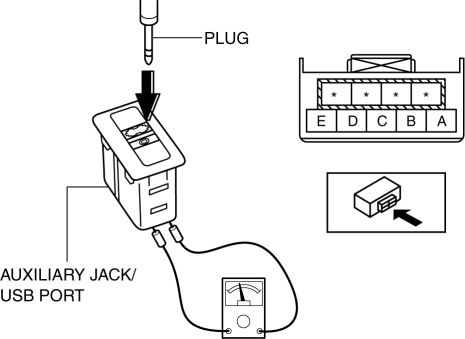
4. Verify that the continuity between the auxiliary jack/USB port terminals is as indicated in the table.
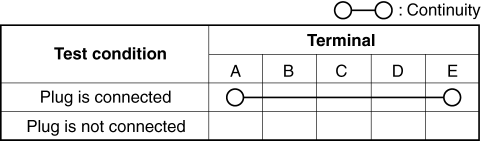
-
If not as indicated in the table, replace the auxiliary jack/USB port.
USB port inspection
1. Disconnect the negative battery cable..
2. Remove the following parts:
a. Upper panel.
b. Shift lever knob (MTX).
c. Selector lever knob (ATX).
d. Shift panel.
e. Side wall.
f. Console.
g. Auxiliary jack/USB port.
3. Insert the pins to positions UA', UB', UC', and UD' shown in the figure from the side of the USB device insertion area for the auxiliary jack/USB port, and verify the continuity at the insertion side and terminal side of the USB device.
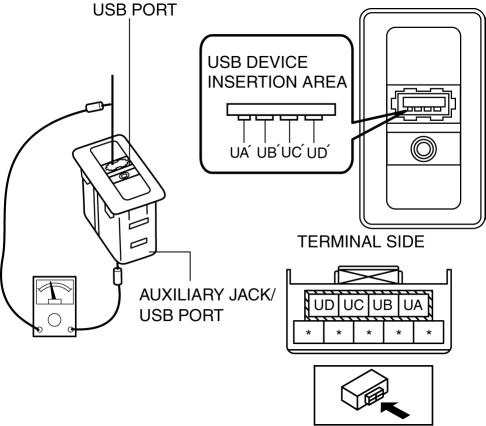
4. Verify that the continuity at the insertion side and terminal side of the USB device is as indicated in the table.
NOTE:
-
When inspecting the USB device insertion side, touch it with a paper clip or similar thin pin without directly inserting a tester into the terminals.
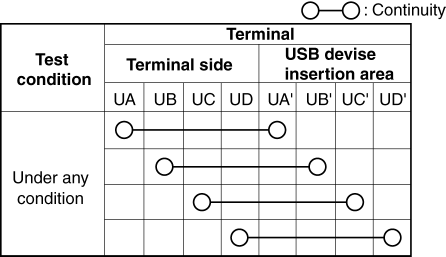
-
If not as indicated in the table, replace the auxiliary jack/USB port.
 Auxiliary Jack/Usb Port
NOTE:
“iPod” is a registered trademark of Apple Inc. in the United States and other
countries.
Purpose, Function
The Auxiliary jack/USB port outputs the audio signals of co ...
 Auxiliary Jack/Usb Port Removal/Installation
1. Disconnect the negative battery cable..
2. Remove the following parts:
a. Upper panel.
b. Shift lever knob (MTX).
c. Selector lever knob (ATX).
d. Shift panel.
e. Side wall.
f. Consol ...
Other materials:
Wheel Unit ID Registration
NOTE:
After the wheel unit replacement, registration of the wheel unit identification
codes must be performed.
ID registration can be done using the M-MDS, or not using the M-MDS.
Using M-MDS
1. Connect the M-MDS to DLC-2.
2. After the vehicle is identified, select th ...
Rear Stabilizer Removal/Installation
1. Remove in the order indicated in the table.
2. Install in the reverse order of removal.
1
Rear stabilizer control link
2
Rear stabilizer bracket
.
3
Rear stabilizer bushing
(See Rear Stabilizer, Rear Sta ...
Motor compartment
Components
Heater coolant reservoir
Washer fluid tank
Power control unit coolant reservoir
12-volt battery
Brake fluid reservoir
Fuse box
Radiator
Condenser
Electric cooling fan
Checking the heater coolant
In the Subaru Solterra, the heater coolant level should always b ...
