
Subaru Solterra 2023-2026 Owner's Manual: Parking Support Brake function (pedestrians rear of the vehicle)
The Subaru Solterra is equipped with a rear camera-based detection system capable of identifying pedestrians behind the vehicle while reversing. When a pedestrian is detected and the system determines that collision risk is elevated, an audible warning is issued. If the danger becomes critical, automatic braking is applied to help reduce collision severity and protect vulnerable road users.
Examples of system operation
This function becomes active when the Subaru Solterra detects a pedestrian behind the vehicle during reverse motion and braking input is insufficient or delayed.
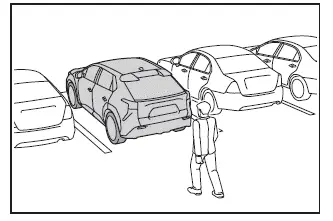
Screen display of pedestrians rear of the vehicle
When a pedestrian is identified within the detection zone, the Subaru Solterra displays clear visual alerts and prompts the driver to react promptly.
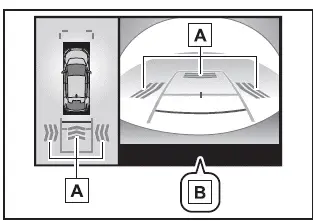
- Pedestrian detection icon
- "BRAKE!" warning message
WARNING
■ If the Parking Support Brake function (pedestrians rear of the vehicle) operates unnecessarily
If the Subaru Solterra system activates unexpectedly, immediately press the brake pedal to regain full control. Manual braking will cancel the automatic intervention.
■ The Parking Support Brake function (pedestrians rear of the vehicle) will operate when
The system activates when the Subaru Solterra meets all of the following conditions:
- EV system output restriction control
- The Parking Support Brake system is enabled.
- The vehicle speed is approximately 9 mph (15 km/h) or less.
- The shift position is set to R.
- A pedestrian is detected behind the vehicle.
- The system determines that enhanced braking is required to prevent a collision.
- Brake control
- EV output restriction control is already active.
- The Subaru Solterra determines that emergency braking is necessary to avoid impact with the pedestrian.
■ The Parking Support Brake function (pedestrians rear of the vehicle) will stop operating when
The Subaru Solterra will discontinue operation in the following situations:
- EV system output restriction control
- The system is turned OFF.
- The system determines that the collision risk has been mitigated.
- The pedestrian is no longer detected behind the vehicle.
- Brake control
- The system is disabled.
- Approximately 2 seconds have passed since the vehicle stopped.
- The driver presses the brake pedal after stopping.
■ Detection area of the Parking Support Brake function (pedestrians rear of the vehicle)
The Subaru Solterra pedestrian detection range for the Parking Support Brake differs from that of the RCD system. As a result, even if the rear camera detection (RCD) identifies a pedestrian and issues a warning, the Parking Support Brake may not always activate, depending on position, distance, and system judgment.
The Subaru Solterra combines radar and camera technologies to provide layered protection while reversing, but drivers must always remain attentive and ready to intervene in dynamic environments.
 Parking Support Brake function (moving vehicles rear of the vehicle)
In the Subaru Solterra, the Parking Support Brake system utilizes
rear radar sensors to continuously monitor traffic approaching from either side
behind the vehicle. When a moving vehicle is detec ...
 Advanced Park
Function description
The Advanced Park system in the Subaru Solterra is designed to deliver a refined
and highly controlled parking experience by assisting the driver during both parking
and exit ...
Other materials:
Maintaining the Finish
Washing
CAUTION
When the wiper lever is in the
position and the ignition is switched ON,
the wipers may move automatically in
the following cases:
If the windshield above the rain
sensor is touched or wiped with a
cloth.
If the windshield is struc ...
Winter driving tips
When operating the Subaru Solterra in winter conditions, it is essential
to carry out thorough preparation and regular inspections before driving. Always
adapt your driving style to current weather and road conditions to ensure maximum
safety, efficiency, and vehicle performance.
Pre-winter p ...
ABS HU/CM Inspection
1. Disconnect the ABS HU/CM connector..
2. Connect the negative battery cable..
3. Attach the tester lead to the ABS HU/CM wiring harness-side connector and
inspect the voltage, continuity, or resistance according to the standard (reference
value) in the table below.
Standard (reference)
...
